What Was Put in Place to Prevent the Chernobyl Disaster to Happen Again
What Russia Is Stirring Up at Chernobyl
The 1986 explosion at the plant was a turning indicate for independence in Ukraine. Now Russia is threatening to make the country relive that trauma.
The Russian military's capture of the Chernobyl nuclear facility in northern Ukraine last week led to heightened levels of both radioactivity and defoliation. Since the infamous 1986 explosion at Chernobyl, which sent nuclear materials as loftier as five miles into the temper and likely condemned far more people than the United nations' projected long-term decease toll of 4,000, the plant has been radioactive. It's defunct. Why would the Russian military desire information technology?
Maybe Russian forces overtook the facility for the sake of convenience—afterward all, information technology's along the route from Russian marry Belarus to Kyiv, the Ukrainian capital letter, which is now nether assault. Or maybe, as Russia's Defense Ministry claimed, the military wanted to protect the plant'southward infrastructure, preventing whatsoever staging of a "nuclear provocation." Or maybe, as a Russian security source told Reuters, it was a warning to NATO.
Whatever the Russian army'southward reasoning, the implication for Ukrainians is articulate: the potential for a echo of the disaster, which they have spent 3 decades and considerable resource trying to prevent. I interviewed scores of cleanup workers in the '90s for my book Life Exposed: Biological Citizens After Chernobyl, and learned merely how securely the memory of the explosion is carved into Ukraine. Russian control of the site "is i of the most appalling threats to Europe today," Ukraine'south Ministry building of Free energy said in a statement concluding week. "Any provocation by the Chernobyl invaders … could plough into another world environmental catastrophe."
This violent run across between "Chernobyl invaders" and Chernobyl survivors is its ain human action of assailment. The disaster at Chernobyl became a rallying weep for Ukrainian independence in the late '80s and early '90s, and processing its traumatic effects on the state'southward people and surround became an of import facet of Ukrainian national identity. By seizing the plant as role of a brutal invasion, Russian federation is stirring upward radioactive particles, and also Chernobyl's painful legacy: Ukrainians' memory of the Soviet Matrimony'due south disregard for their lives.
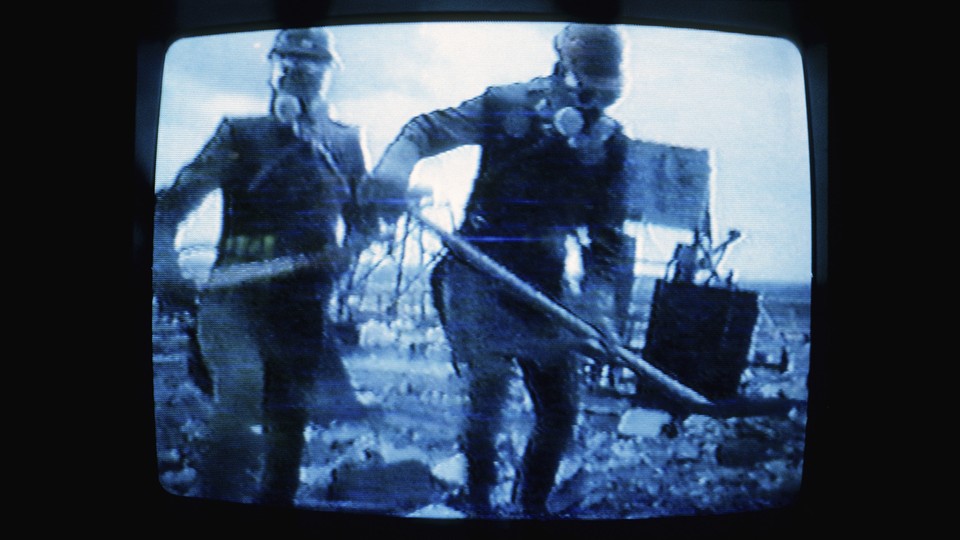
The initial smash at Chernobyl on April 26, 1986, and the massive burn that followed sent fallout across Republic of belarus, Ukraine, Russian federation, and Europe. More subconscious, and more plush to Ukraine, was the process of radiological containment. The efforts lasted more 30 years, until a structure designed to safely hold the unit's highly radioactive remains for a century was completed in 2019. And the work was punishingly concrete: Some people removed chunks of radioactive nuclear core virtually the No. 4 reactor unit with no more equipment than shovels and buckets.
More than than 600,000 soldiers, firefighters, and other workers from across the Soviet Wedlock were sent to the disaster site to clean upward or contain the radiation. Some bulldozed contaminated topsoil while others, in the most dangerous job of all, shoveled highly radioactive droppings into the mouth of the ruined reactor in one-minute stints—plenty time for their bodies to blot a lifetime's worth of radiation exposure. They called themselves "bio-robots," and the one-minute rule was not evenly enforced. During an interview I conducted, a human being on a two-week break from work at the site lifted his pant leg and showed me a patch of skin that had puckered upwards to grade a foreign ring to a higher place his ankle. "This is from radiation," he told me. He counted himself amongst the "living dead": "Our retention is gone. You lot forget everything—we walk similar corpses." The Chernobyl Exclusion Zone, where people cannot live and scientists can stay for only short amounts of time, extends i,000 square miles effectually the reactor site.
The Chernobyl disaster became a turning signal for Ukrainian independence. By the '90s, the Soviet industrial framework was falling apart. Household financial savings were wiped out by hyperinflation. Meanwhile, a Chernobyl health crisis was unfolding as people who developed cancers, heart and autoimmune bug, and other disorders poured into clinics. They were looking for relief from ills that they claimed were related to Chernobyl, but such connections were dismissed by international scientific experts and their Soviet counterparts considering the patients had niggling or no documentation of their exposure. They were faced with an impossible burden of proof, even as the devastating public-wellness consequences of the disaster were downplayed.
In taking over Chernobyl, Russia is implicitly threatening to crusade all that pain all over over again. The 15 active, crumbling nuclear reactors that are spread around Ukraine were non built to withstand an all-out military invasion. Some tin can survive airplane crashes, just probably not inadvertent strikes from missiles or arms. Nor tin they ward off a destabilizing cyberattack, or protect crucial staff members from existence held earnest, every bit the Ukrainian Ministry of Energy said the Russian ground forces has done at Chernobyl. Some of those staff may decide to abscond due to threats of violence. An invading military, in control of those reactors, could dial up the threat of nuclear terror to engage in a wider threat of nuclear blackmail.
Russian control of Ukraine's functioning and decommissioned nuclear power plants would be, in the words of 1 analyst, like having "nuclear warfare without bombs" if these plants were to be tampered with. When the Russian military captured Chernobyl, Vladimir Putin seized the means by which to inflict nuclear damage through a new form of "muddy" power. Russia is now in a position to cause immediate disaster by reopening a toxic legacy that was meant to exist sealed. Information technology could also create uninhabitable zones all around Ukraine and force the land's people back into inhumanely dangerous cleanup piece of work.
Everyone I met in Ukraine in the '90s either knew bio-robots or had one in their family. They were protecting Europe at their own peril, but they knew that it had to be done. The bio-robots' children and grandchildren in Ukraine know exactly how difficult-won nuclear containment at Chernobyl was, and merely how tenuous it is. Nuclear stability, like republic, is a delicate residual. Equally Ukrainians accept upward arms around their country, they are fighting to defend both.
Source: https://www.theatlantic.com/science/archive/2022/03/ukraine-russia-chernobyl-warning/623878/
0 Response to "What Was Put in Place to Prevent the Chernobyl Disaster to Happen Again"
Post a Comment