Is It Still a Mortal Sin if You Dlnt Know It Is a Grave Matter
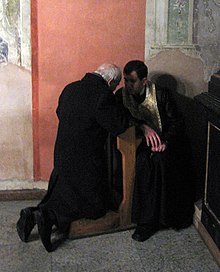
A mortal sin (Latin: peccatum mortale), in Catholic theology, is a gravely sinful act which can lead to damnation if a person does not repent of the sin before death. A sin is considered to be "mortal" when its quality is such that it leads to a separation of that person from God's saving grace. Three conditions must together be met for a sin to be mortal: "Mortal sin is sin whose object is grave matter and which is too committed with full knowledge and deliberate consent."[one] The sin confronting the Holy Ghost and the sins that weep to Heaven for vengeance are considered especially serious.[2] This blazon of sin is distinguished from a impropriety sin that merely leads to a weakening of a person's relationship with God. Despite its gravity, a person tin repent of having committed a mortal sin. Such repentance is the master requisite for forgiveness and absolution.[3] Teaching on absolution from serious sins has varied somewhat throughout history. The current teaching for Catholics was formalized at the 16th-century Quango of Trent.
New Testament [edit]
The term "mortal sin" is thought to be derived from the New Attestation of the Bible. Specifically, it has been suggested that the term comes from the 1 John five:16–17.[4] In this item verse, the author of the Epistle writes "In that location is a sin that leads to expiry."[4] [ clarification needed ]
Fathers of the Church [edit]
The concept is hinted at in some works of the early Fathers of the Church and explicit in others.
In AD 220, Tertullian in his De Modestia, 21 writes,
Discipline governs a homo, ability sets a seal upon him; apart from the fact that power is the Spirit, just the Spirit is God. What, moreover, used [the Spirit] to teach? That at that place must be no communicating with the works of darkness. Discover what he bids. Who, moreover, was able to forgive sins? This is his lonely prerogative: for 'who remits sins but God alone?' and, of course, [who but he tin remit] mortal sins, such as have been committed against himself and against his temple?
In AD 385, Pacian of Barcelona, in his Sermon Exhorting to Penance,[a] gives contempt of God, murder, and fornication as examples of "mortal" or "upper-case letter sins."[6]
In AD 393, St. Jerome writes:[six] [7]
At that place are venial sins and at that place are mortal sins. It is one thing to owe 10 g talents, another to owe just a farthing. We shall have to give an accounting for an idle word no less than for adultery. Merely to be fabricated to blush and to be tortured are not the same thing; not the same affair to abound red in the confront and to exist in desperation for a long time. . . . If we entreat for lesser sins we are granted pardon, but for greater sins, it is difficult to obtain our request. There is a great deviation between i sin and another.
Catholicism [edit]
In the moral theology of Catholicism, a mortal sin requires that all of the following conditions are met:
- Its field of study matter must exist grave. (The term "grave sin" is used at times to indicate grave matter, and at times to indicate mortal sin. Only it always remains true that the following two conditions are requisite for mortal sin.[viii])
- It must be committed with full noesis (and awareness) of the sinful action and the gravity of the offense.
- It must be committed with deliberate and consummate consent.[9]
The Catechism of the Catholic Church defines grave affair:[ten]
Grave matter is specified by the 10 Commandments, respective to the answer of Jesus to the rich beau: "Do not murder, Do not commit adultery, Do not steal, Exercise not deport false witness, Do not defraud, Honor your father and your female parent." The gravity of sins is more or less great: murder is graver than theft. One must too take into business relationship who is wronged: violence against parents is in itself graver than violence against a stranger.
—Canon 1858
This would include worshiping other gods and blasphemy.[11] Although the Church building itself does non provide a precise listing of grave sins or divide actions into grave and venial categories, Church documents do proper noun sure "grave sins" likewise equally "offenses" and "actions" whose subject-matter is considered to be grave. For case, in the area of human sexuality, the Catechism of the Catholic Church building notes that the following actions can involve increased gravity: extramarital sex,[12] divorce[xiii] (but not legitimate separation),[xiv] and masturbation.[15] The sins against the Holy Ghost and the sins that weep to Heaven for vengeance are considered especially serious.[2]
With respect to a person's full knowledge of a certain act existence a grave sin, the Catholic Church teaches that "unintentional ignorance tin can diminish or even remove the imputability of a grave criminal offense. But no 1 is accounted to be ignorant of the principles of the moral law, which are written in the conscience of every human being. The promptings of feelings and passions can too diminish the voluntary and free character of the crime, equally tin can external pressures or pathological disorders (mental disease). Sin committed through malice, by deliberate choice of evil, is the gravest."[16] Furthermore, Catholic teaching also holds that "imputability and responsibility for an action tin can be macerated or fifty-fifty nullified by ignorance, inadvertence, duress, fear, habit, inordinate attachments, and other psychological or social factors."[17] In this regard, a sin committed while 1 is inebriated may lack the awareness and consent necessary for the sin to be mortal. Merely when i becomes enlightened of the danger of excessive drink, such drinking itself becomes a serious affair.
Grave sins should not to be dislocated with the seven mortiferous sins, which are then called because they lead to other sins; they are not necessarily grave sins.
Mortal sins are chosen "grave sins" under the Code of Canon Law due to the "grave" nature of all mortal sins, and the terms are used there interchangeably. This does not deny the distinction given above, that there may be grave affair only not a grave sin if the other weather condition of knowledge and liberty are non present.[18]
Mortal sins must be confessed by naming the specific offence along with how many times it was committed.[xix] Mention of how long since i's last confession is to establish whether i is truly penitent – has a purpose of subpoena.
It is non necessary to confess venial sins although they may exist confessed, a exercise that began with the Irish gaelic monks effectually the 12th century. Venial sins are all sins that are not mortal. The Church encourages frequent, intelligent use of the sacrament of confession even if a person has just venial sins, in view of the benefits that might exist derived.
Co-ordinate to the Catholic Church, no person can receive the Eucharist when in a state of mortal sin:[20]
Anyone who is aware of having committed a mortal sin must non receive Holy Communion, fifty-fifty if he experiences deep contrition, without having kickoff received sacramental absolution, unless he has a grave reason for receiving Communion and there is no possibility of going to confession.
—Canon 1457
Some mortal sins crusade automated excommunication by the very act itself, for example renunciation of faith and faith, known as apostasy,[21] desecration of the Eucharistic species,[22] and "a completed abortion".[23] Those mortal sins are so serious that the Church through law has made them crimes. The Church forbids the excommunicated from receiving any sacrament (non merely the Eucharist) and as well severely restricts the person's participation in other Church liturgical acts and offices. A repentant excommunicated person may talk to a priest, usually in a confessional, well-nigh their excommunication to arrange for the remission. Remission cannot exist denied to someone who has truly repented their deportment and has besides made suitable reparation for amercement and scandal or at least has seriously promised to practice so.[24] [25] However, even if excommunicated, a Catholic who has not been juridically absolved is still, due to the irrevocable nature of baptism, a member of the Catholic Church and therefore must still carry out their obligations of fulfilling their duties of attention Mass, Divine Liturgy, etc. on a Holy Day of Obligation, abstaining from meat on the Fridays of Lent, etc., albeit their communion with the Christ and the Church building is gravely impaired. "Perpetual penalties cannot be imposed or declared by decree."[26] Nonetheless, "the following are expiatory penalties which can affect an offender either perpetually...."[27]
Since the mid-twentieth century, some theologians have taught that a person who lives past a constant attitude of charity is unlikely to fall in and out of God'southward graces without beingness profoundly aware of the change. The term "primal option" arose and is used in a variety of senses.[28] [29]
Pope John Paul II reaffirmed traditional educational activity going back to the Council of Trent in his encyclical Veritatis Splendor, as does the Catechism of the Cosmic Church building, which states: "The pedagogy of the Church affirms the beingness of hell and its eternity. Immediately afterward death the souls of those who die in a state of mortal sin descend into hell, where they suffer the punishments of hell, 'eternal fire'." The Catechism and then adds: "The chief punishment of hell is eternal separation from God, in whom lonely human being can possess the life and happiness for which he was created and for which he longs."[30] However, the Canon does not past name say a specific person is in Hell, but it does say that "...our freedom has the ability to make choices for ever, with no turning back."[31] Virtually significantly, the Catechism as well proclaims that "There are no limits to the mercy of God..."[32] and that "although nosotros tin judge that an act is in itself a grave offence, nosotros must entrust judgment of persons to the justice and mercy of God."[31] We cannot encounter into their heed to know if it was deliberate or committed in full knowledge. Also, like the father in the Parable of the Prodigal Son, God forgives those who repent sincerely. Vatican II, in its Dogmatic Constitution Lumen Gentium, reflects the traditional teaching of the Church on punishment, and on merit or reward for good deeds.[33]
Mortal sin is ordinarily remitted by the priestly absolution in the Sacrament of Penance. However, the effectiveness of the absolution is dependent of the acts of the penitent starting with sorrow for sin or contrition. Perfect contrition (or imperfect contrition, too chosen attrition, in the Sacrament of Penance), coupled with the firm resolution to sin no more and to make recourse to the sacrament of Penance as shortly as possible, tin can restore a person's relationship with God, also as God'southward saving grace, that is, sanctifying grace. This educational activity on perfect contrition is a reminder that God'south mercy and forgiveness is bachelor outside the Sacrament of Penance, all the same, also indicates that Catholics who know about Christ'southward institution of the sacrament of Penance must intend to utilize it. Any human human activity that arises from a person'south love of God, is inspired by God'southward prevenient action and is directed to doing as God requires.[34] When perfect contrition is the ways past which ane seeks to restore one's human relationship with God, there must also be a resolution to confess all mortal sins (that have not been confessed and absolved previously) in the Sacrament of Penance.[35]
Eastern Cosmic churches [edit]
Autonomous, cocky-governing (Latin: sui iuris), Catholic particular churches and liturgical rites in full communion with the Bishop of Rome, the Pope, are known as Eastern Catholic churches.[36] They derive their theology and spirituality from some of the same sources as the Eastern Orthodox and Oriental Orthodox churches,[37] nonetheless use the Latin Cosmic stardom between mortal and venial sin. Nevertheless, names other than mortal and impropriety are often used.[38] [39] [40]
Actions constituting grave affair [edit]
The following is a partial list of actions that are divers as constituting grave matter, according to the Catechism of the Catholic Church or like sources (such as declarations past the Congregation for the Doctrine of the Faith, Apostolic Messages, or other sources printed by Church authorities).
| Proper noun | Description |
|---|---|
| Abortion | "Directly abortion, that is, abortion willed as an finish or as a means,"[41] is "gravely contrary to the moral constabulary. The Church imposes the canonical penalty of excommunication for this criminal offence confronting human life."[41] |
| Encouragement of some other'south grave sins or vices | "Every word or attitude is forbidden which past flattery, adulation, or complaisance encourages and confirms another in malicious acts and perverse conduct. Adulation is a grave error if it makes i an cohort in another's vices or grave sins. Neither the desire to be of service nor friendship justifies duplicitous speech. Adulation is a venial sin when it only seeks to be agreeable, to avoid evil, to meet a demand, or to obtain legitimate advantages."[42] |
| Adultery | "... refers to marital infidelity. When 2 partners, of whom at least one is married to another party, take sexual relations – fifty-fifty transient ones – they commit adultery. Christ condemns even infidelity of mere desire. The sixth commandment and the New Testament forestall adultery absolutely. The prophets denounce the gravity of adultery; they see it as an image of the sin of idolatry."[43] |
| Betrayment | "the full repudiation of the Christian religion"[44] |
| Blasphemy | "...is contrary to the respect due God and his holy name. It is in itself a grave sin."[45] |
| Cheating and unfair wagers | "Unfair wagers and cheating at games constitute grave matter, unless the impairment inflicted is so slight that the i who suffers it cannot reasonably consider it significant."[46] |
| Contraception | "Similarly excluded is whatever activeness which either before, at the moment of, or afterward sexual intercourse, is specifically intended to forestall procreation – whether equally an end or equally a means."[47] "On the other mitt, the Church building does not consider at all illicit the utilize of those therapeutic ways necessary to cure actual diseases, even if a foreseeable impediment to procreation should result there from – provided such impediment is not directly intended for whatsoever motive whatsoever."[48] |
| Detraction | "who, without objectively valid reason, discloses another's faults and failings to persons who did not know them"[49] [50] [51] [52] |
| Defrauding a worker of a just wage | "A merely wage is the legitimate fruit of work. To refuse or withhold it can be a grave injustice. In determining fair pay both the needs and the contributions of each person must be taken into account. 'Remuneration for work should guarantee man the opportunity to provide a dignified livelihood for himself and his family on the material, social, cultural and spiritual level, taking into account the role and the productivity of each, the country of the business organisation, and the common good.' Agreement betwixt the parties is not sufficient to justify morally the amount to be received in wages."[53] |
| Divorce | "If civil divorce remains the only possible way of ensuring certain legal rights, the care of the children, or the protection of inheritance, it tin can be tolerated and does not constitute a moral criminal offence."[54] To endeavor remarriage (outside the Church) without pursuing dissolution of the prior wedlock would plant adultery and and so be a grave matter. |
| Endangerment of human life or safe | ... endangering one'southward own life or the safety of others (due east.1000., by drunkenness, a love of speed on the road, at body of water, or in the air, or gross negligence). |
| Participation in Freemasonry | "The faithful who enroll in Masonic associations are in a country of grave sin and may not receive Holy Communion."[55] |
| Envy | ... if to the level of wishing grave harm to another. |
| Euthanasia | ... of human beings. Euthanising animals is non considered an offense. |
| Farthermost anger | ... at the level of truly and deliberately desiring to seriously hurt or kill someone |
| Fornication | ... is lecherous union between an unmarried man and an single woman."[56] "Among the sins gravely contrary to chastity are masturbation, fornication, pornography, and homosexual practices."[57] |
| Hatred | ... of a neighbour to the point of deliberately desiring him or her slap-up damage |
| Heresy | "the obstinate mail-baptismal denial of some truth which must be believed with divine and catholic organized religion, or it is likewise an obstinate doubt concerning the same"[44] |
| Homosexual actions | "Amidst the sins gravely contrary to chastity are masturbation, fornication, pornography, and homosexual practices."[57] |
| Incest | "... corrupts family relationships and marks a regression toward animality."[58] |
| Lying | Can be a mortal sin. The gravity is measured by "the truth it deforms, the circumstances, the intentions of the one who lies, and the harm suffered by its victims."[59] If not grave matter, lying is a impropriety sin. |
| Masturbation | The gravity is measured by, "the affective immaturity, force of acquired habit, conditions of anxiety or other psychological or social factors that lessen, if not even reduce to a minimum, moral culpability."[lx] "Among the sins gravely contrary to chastity are masturbation, fornication, pornography, and homosexual practices."[57] |
| Missing Mass | "[T]he faithful are obliged to participate in the Eucharist on days of obligation, unless excused for a serious reason (for example, disease, the care of infants) or dispensed by their own pastor. Those who deliberately fail in this obligation commit a grave sin."[61] "Even if in the primeval times [Mass omnipresence] was not judged necessary to be prescriptive, the Church has not ceased to confirm this obligation of conscience, which rises from the inner demand felt so strongly by the Christians of the first centuries. It was merely later on, faced with the half-heartedness or negligence of some, that the Church building had to brand explicit the duty to attend Sunday Mass: generally, this was done in the form of exhortation...The present Code reiterates ... maxim that 'on Sundays and other holy days of obligation the true-blue are bound to nourish Mass'. This legislation has unremarkably been understood as entailing a grave obligation."[62] Merely the gravity of this omission may be seldom realized in practice today.[63] [64] |
| Murder | ... and aiding and abetting in murder. "The 5th commandment forbids doing anything with the intention of indirectly bringing about a person's death. The moral constabulary prohibits exposing someone to mortal danger without grave reason, as well as refusing assistance to a person in danger. The acceptance past homo club of murderous famines, without efforts to remedy them, is a scandalous injustice and a grave law-breaking. Those whose usurious and avaricious dealings lead to the hunger and death of their brethren in the human family indirectly commit homicide, which is imputable to them. Unintentional killing is not morally imputable. But one is non exonerated from grave criminal offence if, without proportionate reasons, he has acted in a way that brings about someone'due south death, even without the intention to practise so."[65] Self-defense or defense of others when at that place is no other, way may involve homicide but does not constitute murder.[66] However, the decease penalty is no longer seen, by the church'south magisterium, as being justifiable.[67] |
| Perjury | "a perjury is committed when he makes a promise under oath with no intention of keeping it, or when after promising on oath he does not keep it."[68] |
| Polygamy | "... is opposite to the equal personal nobility of men and women who in matrimony give themselves with a love that is total and therefore unique and exclusive." The Christian who has previously lived in polygamy has a grave duty in justice to honor the obligations contracted in regard to his former wives and his children.[69] |
| Pornography | "... does grave injury to the dignity of its participants (actors, vendors, the public), since each one becomes an object of base pleasure and illicit profit for others. It immerses all who are involved in the illusion of a fantasy world. It is a grave crime."[70] |
| Practicing magic or sorcery | "All practices of magic or sorcery, past which one attempts to tame occult powers, so as to place them at one's service and have a supernatural ability over others – even if this were for the sake of restoring their wellness – are gravely contrary to the virtue of organized religion. These practices are even more to exist condemned when accompanied by the intention of harming someone, or when they accept recourse to the intervention of demons. Wearing charms is too reprehensible. Spiritism oft implies divination or magical practices; the Church for her part warns the faithful against it. Recourse to so-called traditional cures does not justify either the invocation of evil powers or the exploitation of another'southward credulity."[71] |
| Profanity | ... "failing in respect toward Him in one'south speech; in misusing God'southward name. St. James condemns those 'who blaspheme that honorable name [of Jesus] by which yous are called.' The prohibition of blasphemy extends to linguistic communication against Christ's Church, the saints, and sacred things. ... [profanity in which one takes the proper noun of the LORD in vain] is contrary to the respect due God and His holy name. It is in itself a grave sin. ... The second commandment enjoins respect for the Lord's name. The proper noun of the Lord is holy."[45] [72] [73] |
| Prostitution | "While it is always gravely sinful to engage in prostitution, the imputability of the law-breaking tin can be adulterate by destitution, blackmail, or social pressure."[74] |
| Rape | "... is the forcible violation of the sexual intimacy of another person. It does injury to justice and charity. Rape wounds the respect, liberty, and physical and moral integrity to which every person has a right. It causes grave harm that can marker the victim for life."[75] |
| Sacrilege | " ...consists in profaning or treating unworthily the sacraments and other liturgical deportment, as well as persons, things, or places consecrated to God."[76] |
| Scandal | Deliberately causing someone to sin gravely. |
| Schism | "... the refusal of submission to the Roman Pontiff or of communion with the members of the Church bailiwick to him."[44] |
| Simony | Buying or selling spiritual things, such as sacraments.[77] [78] |
| Stealing / Theft | "Unjustly taking and keeping the property of another, confronting the reasonable volition of the owner. Stealing is a violation of the seventh commandment of God, "You lot shall non steal.""[79] |
| Suicide | "Grave psychological disturbances, anguish, or grave fright of hardship, suffering, or torture tin diminish the responsibility of the 1 committing suicide."[80] "We should not despair of the eternal salvation of persons who take taken their ain lives. By ways known to him lone, God tin can provide the opportunity for salutary repentance. The Church prays for persons who have taken their own lives."[81] |
| Terrorism | "Terrorism threatens, wounds, and kills indiscriminately; it is gravely against justice and charity."[82] |
| Unjust prices | "A simply wage is the legitimate fruit of piece of work. To refuse or withhold information technology tin be a grave injustice. ...'Remuneration for work should guarantee man the opportunity to provide a dignified livelihood for himself and his family on the cloth, social, cultural and spiritual level, taking into account the role and the productivity of each, the state of the business, and the common good.'"[83] |
Eastern Orthodoxy [edit]
According to Father Allyne Smith, "While the Roman Catholic tradition has identified detail acts equally 'mortal' sins, in the Orthodox tradition we see that only a sin for which we don't repent is 'mortal.'"[84]
According to the Mission of The Orthodox Church in America, in answer to a parishioner's query:[85]
In the Orthodox Church at that place are no "categories" of sin equally plant in the Christian West. In the pre-Vatican Ii Catholic catechism, sins were categorized equally "mortal" and "impropriety." In this definition, a "mortal" sin was one which would prevent someone from inbound heaven unless one confessed it before death. ...These categories exercise not exist in the Orthodox Church. Sin is sin. Concerning Confession, having a list of mortiferous sins could, in fact, become an obstacle to 18-carat repentance. For instance, imagine that you commit a sin. You lot look on the list and do not find it listed. It would be very piece of cake to take the attitude that, since information technology is not on a list of mortiferous sins, it is not too serious. Hence, you do not feel the need to seek God's forgiveness right away. A calendar week passes and you accept completely forgotten nigh what you had washed. You never sought God's forgiveness; as a result, you did not receive it, either. We should get to Confession when we sin – at the very least, we should ask God to forgive u.s.a. daily in our personal prayers. Nosotros should not meet Confession as a time to confess but those sins which may be found on a list.
Though not part of the dogma of the Orthodox Church the mortal–venial distinction is causeless by some Orthodox authors and saints as a theologoumenon. For instance, Saint Ignatius Brianchaninov (1807–1867), who wrote primarily for monks, says in his book A Word on Death, in a affiliate entitled "Mortal sin":
It has been said earlier that mortal sin of an Orthodox Christian, not being cured by repentance, submits him to eternal suffering; it has besides been said that the unbelievers, Muslims, and other not-orthodox, even here are the possession of hell, and are deprived of any promise of salvation, being deprived of Christ, the but means of salvation. Mortal sins for Christians are the next: heresy, schism, irreverence, betrayment, witchery, despair, suicide, fornication, adultery, unnatural carnal sins,[b] incest, drunkenness, sacrilege, murder, theft, robbery, and every cruel and brutal injury. But ane of these sins – suicide – cannot be healed by repentance, and every one of them slays the soul and makes the soul incapable of eternal bliss, until he/she cleans himself/herself with due repentance. If a man falls but once in any of these sins, he dies by soul: For whosoever shall keep the whole law, and even so offend in one, he is guilty of all. For he that said, Exercise not commit adultery, said too, Do non kill. Now if g commit no adultery, yet if grand kill, thou art get a transgressor of the law. (James 2:x,eleven)
Similarly, the Exomologetarion of Nicodemus the Hagiorite[86] (1749–1809) distinguishes 7 classes of sin:[87] : 83
- Pardonable
- Nearly the pardonable
- Not-mortal
- Near the non-mortal
- Between the mortal and the non-mortal
- Most the mortal
- Mortal
Nicodemus gives the following example for the seven classes of sin. "The initial movement of acrimony is pardonable; almost to the pardonable is for someone to say harsh words and get hot-tempered. A non-mortal sin is to swear; well-nigh the not-mortal is for someone to strike with the hand. Between the non-mortal and the mortal is to strike with a pocket-size stick; near the mortal is to strike with a large stick, or with a pocketknife, but not in the area of the head. A mortal sin is to murder. A like design applies to the other sins. Wherefore, those sins nearer to the pardonable stop are penanced lighter, while those nearer to the mortal terminate are more than severely penanced."
He also stipulates seven weather of sin:[87] : 100
- Who is the doer of the sin
- What sin was committed
- Why was it committed
- In what mode was it committed
- At what time/age was it committed
- Where was it committed
- How many times was it committed
See also [edit]
- Ancestral sin
- Irreverence against the Holy Ghost
- Blood atonement
- Original sin
- Seven deadly sins
- Sins that cry to heaven
Futher reading [edit]
- O'Neil, Arthur Charles (1912). . In Herbermann, Charles (ed.). Catholic Encyclopedia. Vol. 14. New York: Robert Appleton Visitor.
- Hanna, Edward Joseph (1908). . In Herbermann, Charles (ed.). Catholic Encyclopedia. Vol. 4. New York: Robert Appleton Company.
- Sermon Half-dozen.: On the malice of mortal sin by Alphonsus Liguori in "Sermons for all the Sundays in the year," James Duffy: Dublin (1882).
Notes [edit]
- ^ For full text of sermon, see The Extant Works of Saint Pacian (1842), or online transcription[v]
- ^ Under "unnatural carnal sins" the following are implied: sodomy, animality, masturbation, and any unnatural intercourse betwixt married people (such as using contraceptives, consummated oral or consummated anal intercourse, etc.) as is explained in the book Ascetical Trials, as well written by Saint Ignatius Brianchaninov (1807–1867).
References [edit]
- ^ "Catechism of the Catholic Church - Role three Section 1 Chapter 1 ARTICLE eight". world wide web.scborromeo.org . Retrieved 2020-09-28 .
- ^ a b Gaume, Jean (1883). The Canon of Perseverance; Or, An Historical, Dogmatical, Moral, Liturgical, Apologetical, Philosophical, and Social Exposition of Religion. 1000.H. Gill & Son. p. 871.
Q. What other sins ought we to fear most? A. The other sins that we ought to fear most are sins against the Holy Ghost and sins that cry to Heaven for vengeance.
- ^ Hanna, Edward Joseph (1907). . In Herbermann, Charles (ed.). Catholic Encyclopedia. Vol. i. New York: Robert Appleton Visitor.
- ^ a b i John 5:16
- ^ Pacian, Bishop of Barcelona (1842). "Paraenesis, or, Treatise of exhortation to penance (A.D. 385)". The Extant Works of Saint Pacian. Library of Fathers of the Holy Catholic Church building. Vol. 17. Translated past the Rev. C. H. Collyns. pp. 364–377.
- ^ a b Catholic Answers staff writers (2004). "What the Early on Church Believed: Mortal Sin". Catholic Answers.
- ^ New Advent. "Book Two, Chapter 30". Against Jovinianus (Jerome).
- ^ "Dictionary : GRAVE SIN". www.catholicculture.org . Retrieved 2020-06-29 .
- ^ Article 1859 Canon of the Catholic Church - IntraText; Chapter IV The Gravity of Sin: Mortal and Impropriety Sin – via www.vatican.va
- ^ "Catechism of the Catholic Church building – IntraText". Vatican.va. Retrieved 2012-03-xiii .
- ^ Ex 20:7; Deut 5:11
- ^ "("2390 The sexual deed must take place exclusively within matrimony. Outside of matrimony it always constitutes a grave sin.")". Vatican.va. Retrieved 2012-03-13 .
- ^ "("2384 Divorce is a grave offense against the natural law.")". Vatican.va. Retrieved 2012-03-13 .
- ^ "("2383 The separation of spouses while maintaining the spousal relationship bail tin exist legitimate in sure cases provided for by canon police.")". Vatican.va. Retrieved 2016-12-31 .
- ^ "("2352 ...masturbation is an intrinsically and gravely disordered action.")". Vatican.va. Retrieved 2012-03-13 .
- ^ https://world wide web.vatican.va/archive/ENG0015/__P6C.HTM Article 1860 of The Catechism Of The Cosmic Church
- ^ https://www.vatican.va/archive/ENG0015/__P5N.HTM Article 1735 of The Catechism Of The Cosmic Church building
- ^ "Code of Canon Police: text - IntraText CT". world wide web.intratext.com . Retrieved 2020-06-29 .
- ^ "Code of Catechism Law - IntraText". world wide web.vatican.va . Retrieved 2020-06-29 .
- ^ Canon of the Catholic Church (2nd ed.). Libreria Editrice Vaticana. 2019. Paragraph 1457.
- ^ "Canon 1364.1". Vatican.va. Retrieved 2012-03-13 .
- ^ "Canon 1367". Vatican.va. Retrieved 2012-03-13 .
- ^ "Canon 1398". Vatican.va. Retrieved 2012-03-13 .
- ^ "Code of Canon Police". 1983. p. Can. 1347 §2.
- ^ "Lawmaking of Canon Law". 1983. p. Tin can. 1358 §1.
Remission of a censure cannot be granted unless the offender has withdrawn from contumacy according to the norm of ⇒ can. 1347, §ii; it cannot be denied, however, to a person who withdraws from contumacy.
- ^ "Catechism 1342.2". Vatican.va. Retrieved 2012-03-13 .
- ^ Canon 1336
- ^ "CHRISTIAN MORAL PRINCIPLES : Chapter 16: The Distinction Betwixt Grave and Light Matter". www.twotlj.org . Retrieved 2017-05-03 .
- ^ "Fundamental Option - Lexicon definition of Primal Selection | Encyclopedia.com: FREE online lexicon". www.encyclopedia.com . Retrieved 2017-05-03 .
- ^ Catechism of the Cosmic Church building (2nd ed.). Libreria Editrice Vaticana. 2019. Paragraph 1035.
- ^ a b Catechism of the Cosmic Church (2nd ed.). Libreria Editrice Vaticana. 2019. Paragraph 1861.
- ^ Catechism of the Catholic Church (2nd ed.). Libreria Editrice Vaticana. 2019. Paragraph 1864.
- ^ "Dogmatic Constitution of the Church – Lumen Gentium – Affiliate VII – The Eschatological Nature of the Pilgrim Church and its Marriage with the Church in Heaven No. 48". Second Vatican Council.
Since yet we know not the day nor the hour, on Our Lord'due south communication we must exist constantly vigilant so that, having finished the course of our earthly life,(255) we may merit to enter into the wedlock feast with Him and to be numbered amidst the blessed(256) and that we may non be ordered to become into eternal fire(257) like the wicked and slothful retainer,(258) into the exterior darkness where "in that location will be the weeping and the gnashing of teeth".(259) For before we reign with Christ in glory, all of us will exist made manifest "earlier the tribunal of Christ, and so that each 1 may receive what he has won through the body, according to his works, whether good or evil"(260) and at the end of the globe "they who accept washed practiced shall come forth unto resurrection of life; but those who have done evil unto resurrection of judgment".
- ^ Hardon, Fr. John (2000). Modern Catholic Lexicon. Eternal Life. ISBN096729892X.
- ^ Donovan (STL), Colin (2002). "Perfect Contrition".
- ^ LaBanca, Nicholas (January 2019). "The Other Catholics: A Curt Guide to the Eastern Cosmic Churches: The Other 23 Catholic Churches and Why They Exist". Ascension Press.
- ^ Yurkus, Kevin R. (2005). "The Other Catholics: A Brusk Guide to the Eastern Catholic Churches". www.catholiceducation.org. Catholic Education Resource Eye.
- ^ Patriarch Maximos IV (2014) [First published 1967, in French]. "Chapter iii:The Liturgy". The Greek Melkite Church building at the Quango: Discourses and Memoranda of the Patriarch and the Hierarchs of His Church building at the Second Vatican Ecumenical Quango. Newton, Massachusetts: Sophia Press. ISBN978-0-578-13921-0 – via Eparchy of Newton.
- ^ Chepelskyy, Vasyl (March 2018). "Ask a Priest a Question: Do We Still Adhere to the Concept of Mortal and Impropriety Sins?" (PDF). Eastern Cosmic Life: Official publication of the Byzantine Cosmic Eparchy of Passaic. Woodland Park, New Jersey: Eastern Catholic Press Association. p. 9. Retrieved xx January 2022.
- ^ St. Sophia Ukrainian Greek-Catholic Church (2011). "Frequency of Confession for Eastern Catholics". StSophiaUkrainian.cc. The Colony, Texas. Retrieved 20 January 2022.
- ^ a b Catechism of the Cosmic Church (2d ed.). Libreria Editrice Vaticana. 2019. Paragraph 2322.
- ^ Catechism of the Catholic Church building (2nd ed.). Libreria Editrice Vaticana. 2019. Paragraph 2480.
- ^ Catechism of the Catholic Church (2nd ed.). Libreria Editrice Vaticana. 2019. Paragraphs 2380–2381.
- ^ a b c Canon of the Catholic Church (2nd ed.). Libreria Editrice Vaticana. 2019. Paragraph 2089.
- ^ a b Catechism of the Catholic Church (2nd ed.). Libreria Editrice Vaticana. 2019. Paragraph 2148.
- ^ Catechism of the Cosmic Church (second ed.). Libreria Editrice Vaticana. 2019. Paragraph 2413.
- ^ "Paragraph 13", Humanae Vitae , retrieved Nov 13, 2016
- ^ "Paragraph 19", Humanae Vitae , retrieved Nov thirteen, 2016
- ^ Canon of the Catholic Church (second ed.). Libreria Editrice Vaticana. 2019. Paragraphs 2477–2479.
- ^ Joseph Delany (1908). "Detraction". Cosmic Encyclopedia . Retrieved 2013-04-23 .
- ^ Edward P. Sri (September–October 2010). "The Fine art of Living: The Feathers of Gossip". Lay Witness.
- ^ Ferreol Girardey (1916), Charles J. Callan (ed.), "Detraction Cannot Be Repaired", Illustrations for Sermons and Instructions, New York: Joseph F. Wagner, p. 353
- ^ Catechism of the Cosmic Church building (2nd ed.). Libreria Editrice Vaticana. 2019. Paragraph 2434.
- ^ Catechism of the Catholic Church (second ed.). Libreria Editrice Vaticana. 2019. Paragraph 2383.
- ^ Announcement on Masonic associations
- ^ Catechism of the Catholic Church (2nd ed.). Libreria Editrice Vaticana. 2019. Paragraph 2353.
- ^ a b c Catechism of the Catholic Church (2nd ed.). Libreria Editrice Vaticana. 2019. Paragraph 2396.
- ^ Canon of the Catholic Church (2d ed.). Libreria Editrice Vaticana. 2019. Paragraph 2388.
- ^ Compendium of the Catechism of the Cosmic Church. pp. ref num 523.
- ^ Catechism of the Cosmic Church (second ed.). Libreria Editrice Vaticana. 2019. Paragraph 2352.
- ^ Catechism of the Catholic Church building (2nd ed.). Libreria Editrice Vaticana. 2019. Paragraph 2181.
- ^ Pope John Paul II. "Churchly Letter: Dies Domini (May 31, 1998)". w2.vatican.va . Retrieved 2017-05-02 .
- ^ "Missing Lord's day Mass is not a mortal sin, says Archbishop". contained . Retrieved 2020-06-29 .
- ^ Consecrated Phrases: A Latin Theological Lexicon. Collegeville, Minnesota: Lodge of Saint Benedict (Benedictine Social club); Liturgical Press. 2013. p. 234. ISBN9780814682142.
...this expression [the Latin phrase "sub gravi"] was used primarily in 1 of two senses in the traditional manuals of moral theology...Thus, attendance at Sunday Mass was taught as obliging "sub gravi"...other theologians used this expression as a warning of some potential grave danger which should be avoided and therefore pointed to the importance of a certain affair (such equally not missing participating in the Sunday Eucharist) without necessarily concluding that if 1 deliberately missed a Sunday celebration she or he would exist guilty of mortal sin every bit such.
- ^ Catechism of the Catholic Church (2nd ed.). Libreria Editrice Vaticana. 2019. Paragraph 2269.
- ^ Catechism of the Cosmic Church (2nd ed.). Libreria Editrice Vaticana. 2019. Paragraphs 2263–2265.
- ^ Povoledo, Elisabetta; Goodstein, Laurie (2018-08-02). "Pope Francis Declares Death Penalty Unacceptable in All Cases". The New York Times. ISSN 0362-4331. Retrieved 2020-06-29 .
- ^ Catechism of the Catholic Church (2nd ed.). Libreria Editrice Vaticana. 2019. Paragraph 2152.
- ^ Catechism of the Catholic Church building (2nd ed.). Libreria Editrice Vaticana. 2019. Paragraph 2387.
- ^ Catechism of the Catholic Church (2nd ed.). Libreria Editrice Vaticana. 2019. Paragraph 2354.
- ^ Catechism of the Cosmic Church (2d ed.). Libreria Editrice Vaticana. 2019. Paragraph 2117.
- ^ Catechism of the Catholic Church (2nd ed.). Libreria Editrice Vaticana. 2019. Paragraph 2161.
- ^ "Oct 27 - Homily: Is Swearing a Sin?". Franciscan Friars of the Immaculate. 27 October 2014. Archived from the original on 2021-12-21. Retrieved 5 July 2019.
- ^ Catechism of the Catholic Church (2nd ed.). Libreria Editrice Vaticana. 2019. Paragraph 2355.
- ^ Catechism of the Catholic Church building (2nd ed.). Libreria Editrice Vaticana. 2019. Paragraph 2356.
- ^ Catechism of the Catholic Church (2d ed.). Libreria Editrice Vaticana. 2019. Paragraph 2120.
- ^ Canon of the Catholic Church (2nd ed.). Libreria Editrice Vaticana. 2019. Paragraph 2121.
- ^ Weber, Nicholas (1912). "Simony". Catholic Encyclopedia. Vol. 14. Retrieved Baronial 31, 2014.
- ^ "Canon of the Catholic Church". www.usccb.org . Retrieved 2021-06-05 .
- ^ Canon of the Cosmic Church (2nd ed.). Libreria Editrice Vaticana. 2019. Paragraph 2282.
- ^ Catechism of the Catholic Church (2nd ed.). Libreria Editrice Vaticana. 2019. Paragraph 2283.
- ^ Canon of the Catholic Church (2nd ed.). Libreria Editrice Vaticana. 2019. Paragraph 2297.
- ^ "Catechism of the Catholic Church - IntraText". www.vatican.va. 2434. Retrieved 2020-06-29 .
- ^ (Fr. Allyne Smith, in G. East. H. Palmer, Philip Sherrard, and Bishop Kallistos Ware, trs., Phylokalia: The Eastern Christian Spiritual Texts (Skylight Press, 2000), p. 2).
- ^ "Sin," Orthodox Church in America website: http://www.oca.org/qa.asp?id=153&sid=iii
- ^ "Nicodemus of the Holy Mountain". OrthodoxWiki. 2011-08-25. Retrieved 2012-03-13 .
- ^ a b Dokos, George, ed. (2006). The Exomologetarion of Saint Nicodemus the Hagiorite: A transmission of confession. Translated past Fr. George Dokos. Thessalonica, Greece: Uncut Mountain Press. ISBN960-86778-iii-ane.
External links [edit]
- Catechism of the Catholic Church from the official website of the Vatican
- The Council of Trent - Session 14 - The quaternary nether the Supreme Pontiff, Julius Three, celebrated on November 25, 1551 - The Most Holy Sacraments Of Penance And Extreme Unction
- Extract from the Exomologetarion of Nicodemus the Hagiorite
Source: https://en.wikipedia.org/wiki/Mortal_sin#:~:text=(The%20term%20%22grave%20sin%22,the%20gravity%20of%20the%20offense.
0 Response to "Is It Still a Mortal Sin if You Dlnt Know It Is a Grave Matter"
Post a Comment